

How can family-owned tourism businesses preserve the knowledge, relationships and identity that have made them successful while also giving the next generation room to lead, innovate and shape the future?
This question was at the centre of Next GEN Tourism’s participation in the 34th Nordic Symposium on Tourism and Hospitality Research, held in Reykjavík, Iceland, from 6–8 October 2026.
The symposium brought together approximately 190 researchers and tourism professionals from 27 countries under the theme “Tourism in a Changing World: An Active Agent for Good?”. Organised by the Icelandic Tourism Research Centre, the event included 165 presentations across 28 sessions, alongside workshops, panel discussions and opportunities for exchange between researchers and tourism professionals.
For Next GEN Tourism, the symposium provided an important opportunity to present emerging project research on succession readiness and to discuss one of the central challenges facing many tourism SMEs across Europe: how to manage generational transition without losing the knowledge, relationships and character that give a business its identity.
Keeping the spirit alive: succession as more than ownership transfer
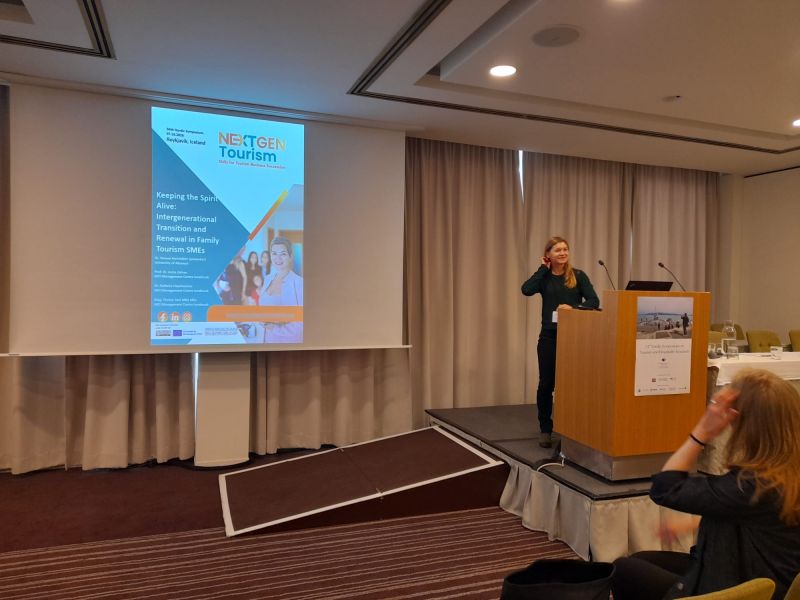
Representing Next GEN Tourism, Dr Verena Karlsdóttir from the University of Akureyri presented the paper:
“Keeping the Spirit Alive: Intergenerational Transition and Renewal in Family Tourism SMEs”
The paper was co-authored with Prof. Dr Anita Zehrer, Stefanie Haselwanter and Florian Sexl from MCI Management Center Innsbruck.
The presentation drew on focus-group research conducted with tourism SMEs and other stakeholders in Iceland, Austria and Slovenia. Rather than treating succession primarily as a legal or financial transaction, the research examined what actually needs to be transferred between generations for a tourism business to remain viable and recognisable. The findings point to several elements that are particularly important for family-owned and closely held tourism businesses.
First, much of the value of a tourism SME is not formally documented. Owners often carry extensive tacit knowledge about customers, suppliers, employees, seasonal operations, local networks and destination-specific practices. If this knowledge remains concentrated in one person, the business may become vulnerable when leadership changes. Second, succession depends heavily on relationships and trust. Tourism businesses often operate through long-standing connections with local suppliers, destination partners, repeat guests and community actors. These relationships cannot simply be handed over at the moment of ownership transfer. Successors need time to become visible, credible and trusted by the people around the business. Third, the findings underline the importance of leadership transition and communication between generations. A successful handover requires clarity around changing roles, decision-making authority and expectations. The previous generation needs to be able to transfer responsibility, while successors need sufficient space to develop their own leadership approach. Finally, the research highlights the tension between continuity and renewal. Previous generations may have built the reputation, culture and identity of the business over many years. These are important assets. At the same time, successors often bring new skills, technologies, market knowledge and ideas. The challenge is therefore not to choose between preserving the past and changing the business. It is to identify what should remain recognisable, what must be transferred carefully, and what needs to evolve.
Connecting succession readiness with wider tourism resilience
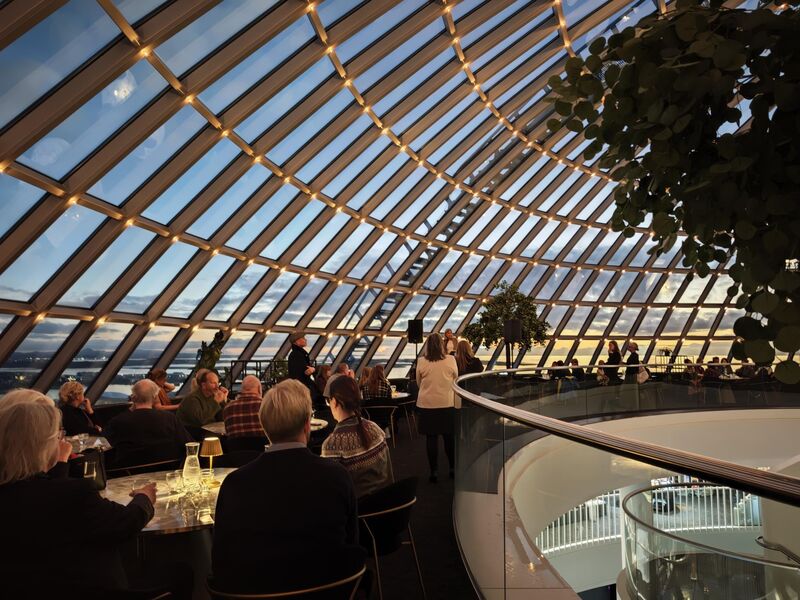
The broader themes of the symposium reinforced this perspective. The event opened with a reception at Reykjavík’s Perlan, where Iceland’s Minister of Industries, Hanna Katrín Friðriksson, welcomed participants. The main scientific programme began the following day at Hotel Reykjavík Askja.
A keynote by Arnar Már Ólafsson, Director General of the Icelandic Tourist Board and Vice-President of the European Travel Commission, addressed the theme “Tourism in a Changing World: From Growth to Stewardship.” His contribution encouraged a broader understanding of tourism success, including the protection of destinations, support for communities and creation of long-term value.
Professor Henna Konu from the University of Eastern Finland also contributed to discussions on regenerative tourism and the positive role tourism businesses can play within their destinations and communities. These discussions connect closely with succession readiness. Tourism resilience is not only about visitor numbers, market adaptation or new technologies. It also depends on whether locally embedded tourism businesses can continue operating, retain critical knowledge and relationships, and renew themselves as ownership and leadership change. In rural and peripheral destinations, the continuity of family-owned tourism SMEs can have wider effects on local employment, supplier networks, community identity and the overall visitor experience.
Turning research into practical support
The findings presented in Reykjavík feed directly into the development of the Next GEN Tourism Succession Readiness Framework. The framework approaches succession as a multidimensional capability rather than a single transfer event. It brings together areas such as leadership transition, ownership and governance, strategic renewal, financial planning and risk, the wider tourism ecosystem, intergenerational relationships, and brand and market positioning. This broader perspective reflects what emerged from the project’s research: businesses need more than legal documents and financial arrangements to become genuinely ready for succession.
The next step is to translate this research into practical resources. Through the project’s curriculum, Toolbox and digital resources, Next GEN Tourism aims to help tourism SME owners, potential successors and vocational education and training providers identify areas of strength, recognise gaps and start preparing for transition earlier.
A gradual approach to succession gives owners and successors more time to transfer knowledge, clarify roles and prepare for change before retirement, illness or other unexpected circumstances force a rushed transition. Practical preparation may include documenting critical business knowledge, gradually transferring customer and supplier relationships, clarifying future leadership roles, discussing expectations between generations, assessing financial readiness and identifying areas where the successor may want to renew or reposition the business.
Bringing Next GEN Tourism into the international discussion
Participation in the Nordic Symposium was therefore more than an opportunity to present a single research paper. It allowed Next GEN Tourism to place succession readiness within wider international discussions about tourism resilience, sustainability, local communities and the long-term future of tourism SMEs. It also provided an opportunity to exchange perspectives with researchers and practitioners working across different tourism contexts and to strengthen awareness of succession as an issue that deserves greater attention in tourism research, education and business support.
For family-owned tourism businesses, succession is rarely simply the moment when one generation leaves and another takes over. It is a period in which knowledge, relationships, authority, identity and future direction all have to be negotiated. The research presented in Reykjavík reinforces one of the central ideas behind Next GEN Tourism: successful transition requires both continuity and renewal.
The aim is not to preserve every existing practice unchanged, nor to replace everything that came before. Instead, businesses need to understand what makes them distinctive, ensure that essential knowledge and relationships are transferred, and create enough space for the next generation to develop new capabilities and respond to changing tourism markets.
By combining research, education and practical tools, Next GEN Tourism seeks to support tourism SMEs in preparing for that transition before it becomes a crisis – helping businesses preserve what matters, adapt where necessary and remain resilient across generations.